
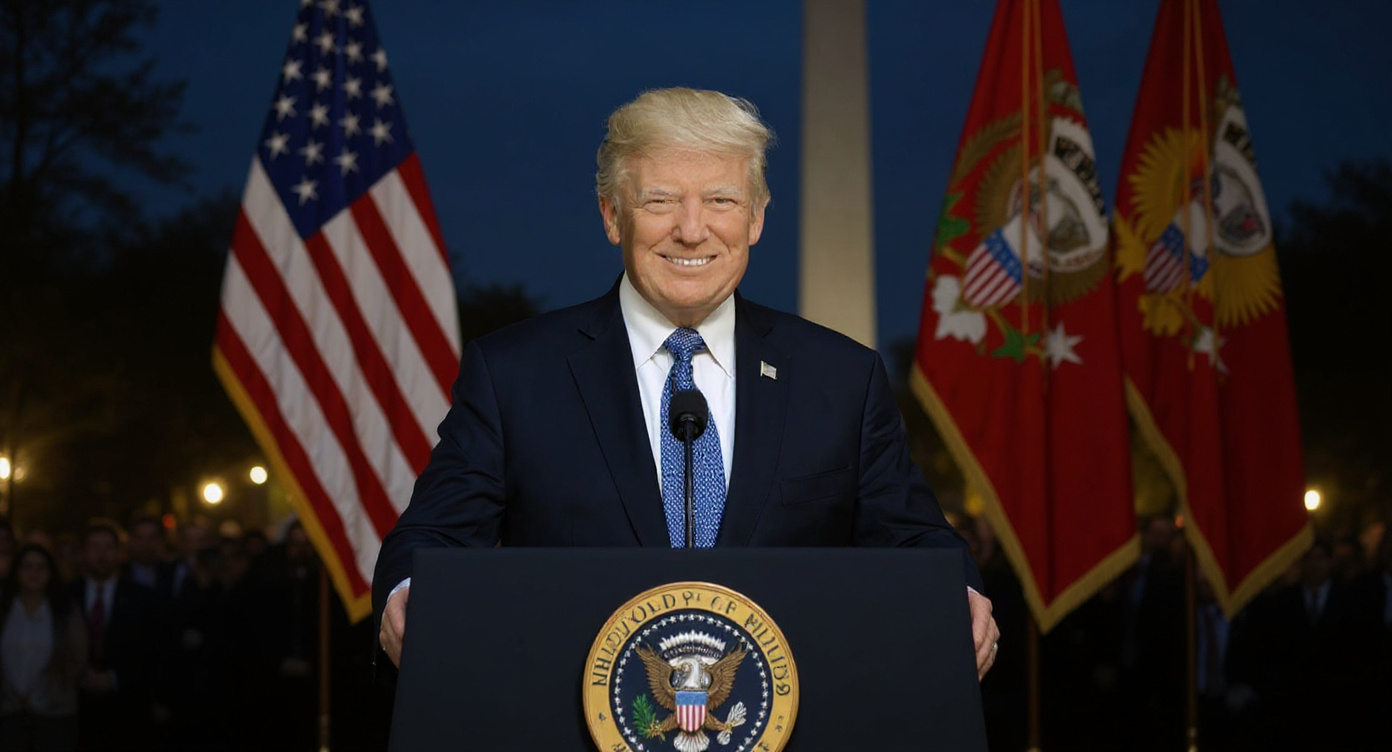
Corporal Patrick Finn and Private First Class Rudy Meekins stood on the National Mall on Saturday night, two men who survived the frozen hell of the Chosin Reservoir in Korea. President Trump called them forward by name, and the crowd — delayed by thunderstorms but not diminished by them — gave them the kind of ovation that used to be automatic in this country.
That moment tells you everything about the speech that followed.
Trump addressed the nation from Washington, D.C. on Saturday evening, July 5th, marking America's 250th birthday with a speech that leaned hard into the thing his opponents hate most: unapologetic American exceptionalism. Historical flags from battles spanning two and a half centuries lined the stage. Veterans from across the last 250 years of conflict were honored. And Trump, as reported by the Daily Wire, delivered lines that would make a globalist's eye twitch involuntarily.
"The hope, the promise, the light, and the glory among all of the nations," Trump said of the United States. Then the kicker: "They try and be like us. Nobody can be like us."
Not "we're one country among many." Not "we have lessons to learn from our European partners." Nobody can be like us. Period.
The speech tracked the full arc of American history — revolution, expansion, world wars, Cold War — and landed squarely on the ideological fight happening right now. Trump pointed to the veterans on stage and drew the line directly.
"Our warriors did not fight communism on battlefields across the world, only to have that menace rear its ugly head right back here in America," he said. "We're not going to let it happen."
He wasn't being metaphorical. He wasn't doing the polite Republican thing where you gesture vaguely at "big government" and let the audience fill in the blanks. He called it what it is.
"We don't want communists in our country. Never worked, and it never will work."
Then he compared it to cancer. "Like a cancer. You got to cut it out, you got to cut it out fast."
Now, the usual response from the credentialed class will be that calling anything in American politics "communism" is hyperbolic. These are the same people who spent four years calling Trump a fascist dictator without a trace of irony. The Democratic Socialists of America just swept New York City council races last month. Their platform includes abolishing ICE, defunding police, and socializing housing. But sure — calling that communist-adjacent is the real overreach.
The thunderstorms that delayed the event are worth noting, because in a different administration they'd be the story. Remember when Trump's Inauguration crowd got the weather treatment from every outlet with a camera? Saturday's storms came and went. The crowd stayed. The speech happened. Nobody melted.
"After 250 years, the Spirit of 1776 still lives within us all," Trump told them.
There's a reason that line lands differently in 2026 than it would have in, say, 2015. We've now spent the better part of a decade watching institutions — from universities to federal agencies to the military brass — treat the founding principles of this country as something to be apologized for. The 1619 Project wasn't an academic exercise. It was a replacement narrative, and it got a Pulitzer.
So when a sitting president stands on the National Mall and says the spirit of the founding isn't dead, isn't shameful, and isn't negotiable, that's not a greeting card sentiment. It's a position statement. And right now, it's a controversial one — which tells you everything about where the other side has moved.
Trump closed with the line that doubles as the thesis of his entire political career: "Our destiny is written by God."
"With God's help, we can always be this or even better," he said.
Two Korean War veterans stood in the July heat on the National Mall, sixty-some years after they froze at Chosin. The president called them by name. The crowd roared. The flags of every American conflict hung behind them.
That used to just be called the Fourth of July. Now it's a political statement.