
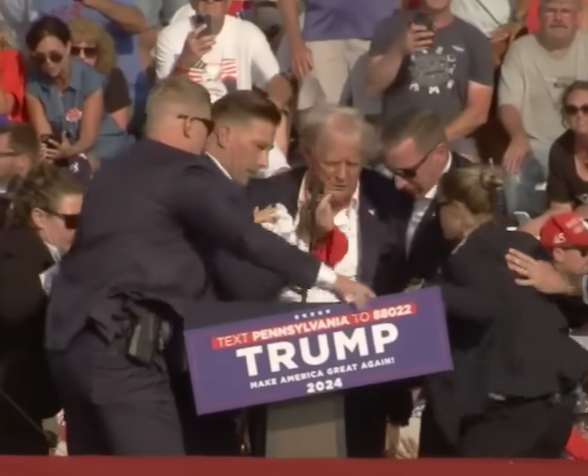
At 6:09 p.m. on July 13, 2024, local law enforcement called the Secret Service communications room at the Butler, Pennsylvania rally to warn them: there's a suspicious person on the roof of the American Glass Research complex, 155 yards from the stage where Donald Trump was speaking. The counter-drone operator who took the call didn't ask where the building was. He opened a web browser and started Googling it.
Two minutes later, Thomas Crooks opened fire. The operator was still searching.
That detail — buried in a DHS Office of Inspector General report released July 2 — is somehow both the most absurd and the most representative finding in a document full of them. According to the report, as reported by the New York Post, "instead of asking local law enforcement personnel for the AGR complex's location, the counter drone operator searched online for it, and was still searching when Crooks fired his first shots."
Crooks fired eight rounds. He killed Corey Comperatore, a retired volunteer fire chief who shielded his family with his own body. He seriously wounded two other rallygoers. He grazed Trump's ear after the President turned his head slightly at the last second. And through it all, a man whose job was to detect aerial threats to the President was browsing the internet like a confused tourist trying to find a restaurant.
The Inspector General's report lays out a cascade of failures that would get a Wendy's shift manager fired. The Secret Service's counter-drone system — the one piece of equipment specifically designed to detect something like the drone Crooks flew over the rally site two hours before the shooting — was offline due to a broken Ethernet cable. The lone operator assigned to run it had received just 20 minutes of informal instruction on the equipment. He called the vendor at noon. He connected with tech support at 1:11 p.m. By 3:04 p.m., the vendor said the issue needed to be escalated. The system was restored at 4:29 p.m. — after Crooks had already flown his drone for nearly nine minutes, surveying both the stage and the rooftop he'd later shoot from, completely undetected.
The report noted that "had experienced Technical Security Division personnel been assigned as originally requested, the malfunction likely would have been resolved" before Crooks ever got his drone airborne.
Then there's the communications disaster. Local law enforcement transmitted 102 radio warnings about a suspicious person — later identified as Crooks — that the Secret Service never heard. Not because the radios didn't work. Because the Secret Service set up its communications room 257 yards from the local mobile command center and never established a joint channel. The agency received only five phone calls and three text messages about Crooks. Three separate radio reports that Crooks was on the roof with a rifle never reached the protective detail at all.
"The Secret Service would have delayed Trump's speech or removed him from the stage had they been aware of the search for Crooks," the report states. The information existed. It was being broadcast. The people whose entire job was to receive it simply weren't listening.
The report also revealed that a proposed truck placement that would have blocked the line of sight from the AGR rooftop to the stage was rejected over concerns about the "press shot" — the camera angle. Someone decided a clean photo op mattered more than a physical barrier between a sniper's perch and a presidential candidate.
The IG issued seven recommendations. The report found that lead agent Miyo Perez was relatively inexperienced for an event of this magnitude, and that Secret Service Director Sean Curran had personally signed off on the Butler site security plan. Multiple agents have since been suspended without pay. Two supervisors later received promotions.
"The Secret Service's overall lack of policy and processes, coupled with limited intelligence sharing and poor collaboration and communication with protectee staff and state and local law enforcement, set the conditions that led to missing opportunities to prevent and detect the attempted assassination," the report concluded.
One hundred and two warnings. A drone flying undetected for nine minutes. A broken cable nobody could fix. A rooftop nobody secured. A phone call answered by a man who responded by opening Google.
Corey Comperatore's family doesn't get a seven-point recommendation list. They get a folded flag.