
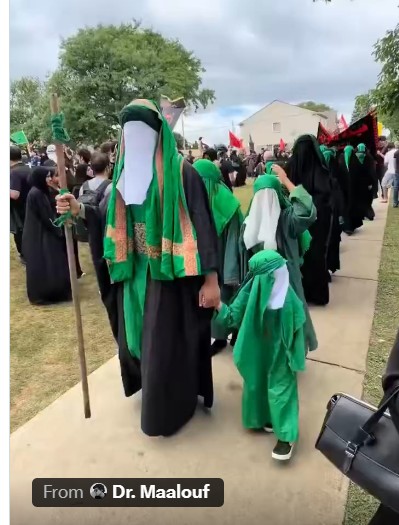
A viral video posted to X by Libs of TikTok on August 5th shows a crowd of men in Dearborn, Michigan, wearing head and face coverings, marching through the streets carrying flags to celebrate a Democratic Senate primary victory. The caption read: "Welcome to Afghanistan… Jk. It's Dearborn, Michigan. And Democrats just elected a Muslim for Senate."
The man they're celebrating is Abdul El-Sayed, a 41-year-old doctor who just defeated Rep. Haley Stevens by a single percentage point to win Michigan's Democratic Senate nomination. If he wins in November, he'd become the first Muslim U.S. senator in American history.
President Trump seems pleased about the matchup. He called El-Sayed's victory "great news" for the Republican Party and labeled the candidate a "Communist loser."
El-Sayed is a former Detroit health director who ran for governor in 2018 and lost to Gretchen Whitmer in the primary. He co-wrote a book in 2021 called Medicare for All: A Citizen's Guide. He has appeared at Democratic Socialists of America events going back to his 2017 gubernatorial run. At a 2019 DSA event that raised $10,000 for the organization, DSA organizers introduced him as "a longtime friend of Detroit DSA." His platform includes universal healthcare and eliminating corporate donations from politics.
But he insists he's not a socialist. He calls himself a capitalist.
The primary results tell the real story of where the Democratic Party is heading. El-Sayed pulled 48.49 percent of the vote to Stevens' 47.51 percent — a one-point margin — while overcoming a nearly $65 million onslaught of outside money and opposition from the entire Democratic establishment. That's not a fluke. That's a base that wanted the radical option.
And the company he keeps is worth noting. On April 7th, El-Sayed held rallies with political streamer Hasan Piker at college campuses in Ann Arbor and East Lansing. Piker — the same commentator who said America "deserved" 9/11 — drew national attention and a wave of criticism from Michigan Democrats and Jewish community leaders. El-Sayed refused to disavow Piker's controversial past. He also railed against AIPAC, calling the war in the Middle East "genocidal" and claiming that AIPAC has "decimated our politics and made us think that the most important goal of our foreign policy is to backstop Israel."
Speaking of AIPAC — the pro-Israel group spent nearly $30 million in ads against El-Sayed during the primary, painting him as a radical. It didn't work. El-Sayed also faced backlash over leaked audio from a private campaign strategy call held one day after the death of former Iranian Supreme Leader Ali Khamenei, in which he said he didn't want to comment publicly because of "community sadness" in Dearborn.
The "he's not really that radical" defense is already being assembled. El-Sayed told voters he reached out to Jewish communities, calling them "sisters and brothers" and promising commitment to their safety. Stevens, to her credit, released a gracious concession, calling El-Sayed "a doctor, a community health official, a Rhodes Scholar, and a dedicated Michigander" and offering her full support heading into November. That's the party line now — unify behind the progressive, pretend the primary never happened.
What happened in Dearborn after the results came in is a snapshot of a political realignment that most of the media would rather not discuss. The Arab and Muslim American vote didn't just show up for El-Sayed — it carried him across the finish line in a race the establishment spent $65 million trying to win. That voting bloc flipped Dearborn for Trump in 2024. Now it's flexing again, this time pulling the Democratic Party further left than its leadership wanted to go.
El-Sayed now faces Republican Mike Rogers, who ran unopposed for the GOP nomination, in what will be one of the most consequential Senate races of 2026. Rogers has Trump's endorsement. Republican groups are already running ads calling El-Sayed "too radical" for Michigan.
A DSA-adjacent candidate who campaigns with Hasan Piker, rails against AIPAC, dodges questions about Iran's Supreme Leader, and calls himself a capitalist. Michigan voters will get to decide in November which part of that sentence they believe.