
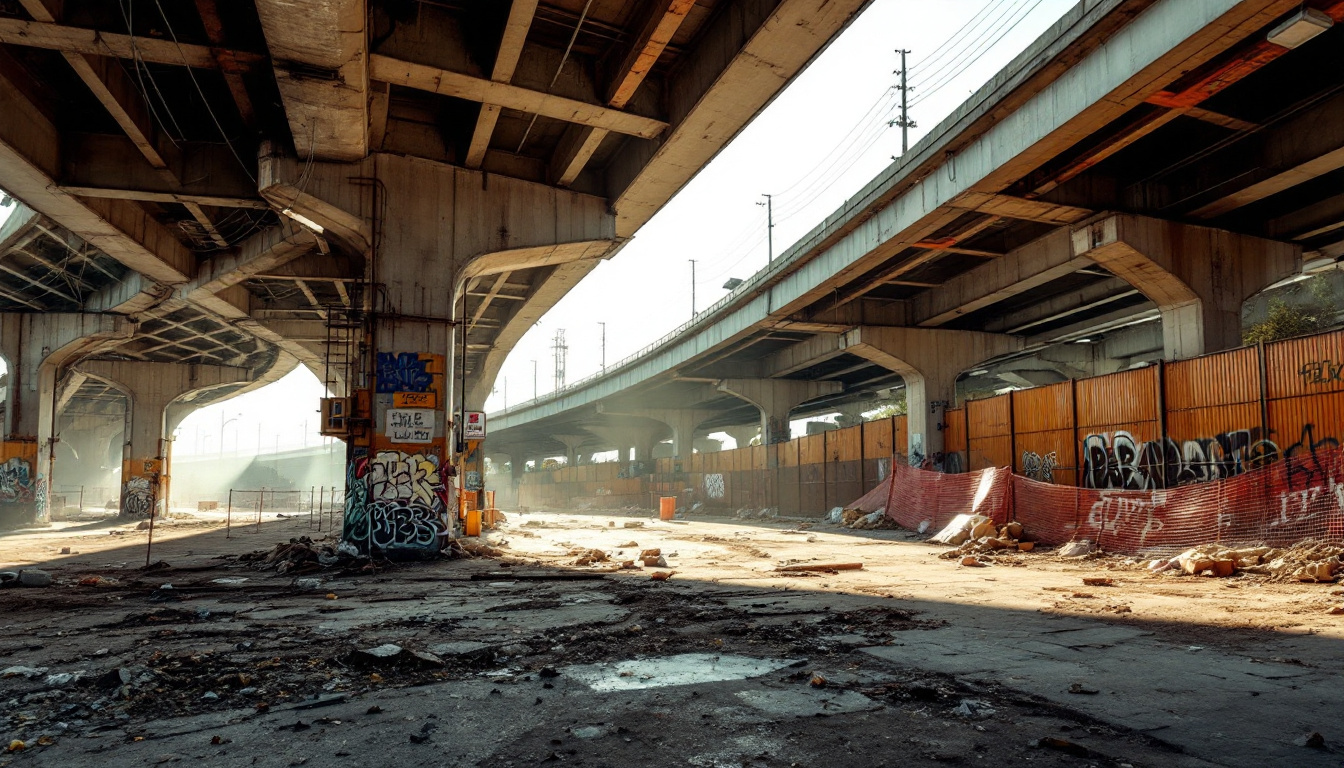
The Sixth Street PARC — that stands for Park, Arts, River, and Connectivity, because nothing screams "urban renewal" like a government acronym — is a 12-acre stretch of land running from the Arts District to Boyle Heights in Los Angeles. It cost taxpayers $82 million. It has playgrounds, a soccer field, a splash pad, green space. It also has graffiti, copper wire thieves, and street takeovers.
The park hasn't opened yet.
The massive public works project sits mostly underneath the Sixth Street Bridge — a nearly $600 million structure that's already had its copper wiring ripped out by thieves, leaving portions of the bridge without functioning lights. So the city built an $82 million park underneath a $600 million bridge that can't keep its own lights on. Combined tab to taxpayers: north of $680 million. Combined security plan: TBD.
Tom Trafelet, a neighbor who organized a petition urging city leaders to designate the park a 41.18 no-camping zone, has already gathered hundreds of signatures from residents who can see exactly where this is headed. He told FOX 11 the graffiti covering the construction site speaks for itself: "Some of it's kind of arty, but most of it is crap."
Trafelet isn't being dramatic. He's being specific. "The cultural and financial ecology of our neighborhood is at stake and we need to do something about this," he said. The petition asks for a no-camping designation before the park opens — a preemptive move, because the residents of this neighborhood have watched this movie before.
So has Margarita Amador, another nearby resident. "We definitely don't want a MacArthur Park duplication," she told FOX 11. "We foresee that happening." For anyone unfamiliar, MacArthur Park is the Los Angeles landmark that went from public green space to open-air drug market so reliably that it became a national punchline. Amador wants to use the soccer field. She wants to bring kids to the splash pad. "We want to be able to enjoy our soccer field. We want to be able to enjoy our splash pad," she said. Basic stuff. Taxpayer-funded amenities being used by taxpayers. Radical concept in Los Angeles.
Councilmember Ysabel Jurado released a statement that read like it was drafted by a communications intern who'd just discovered the word "accountability." She said: "The Sixth Street PARC represents an $82 million public investment, and residents deserve a park that is safe, welcoming, and well maintained from day one." She then added: "Keeping this park safe cannot begin and end with fencing or a 41.18 designation. It requires clear accountability, consistent maintenance, regular programming, and a coordinated response when concerns arise."
Translation: Jurado doesn't want to commit to the no-camping zone. She wants meetings. She wants a "coordinated response." She wants a proposed park advisory board for resident input — which, if you've spent any time in city government, is where good ideas go to die in a binder nobody reads.
The city's official security plan, such as it is, involves the LAPD providing live monitoring of security cameras once the park opens. The Department of Recreation and Parks will handle maintenance. The Office of Community Beautification — yes, that's a real office — will manage graffiti removal. Construction is expected to wrap before the end of 2026, though no firm opening date has been announced. So we have a timeline for building it. We just don't have a timeline for keeping it from turning into MacArthur Park with newer benches.
The residents signing Trafelet's petition aren't asking for anything extravagant. They're asking the city to enforce basic rules at a park the city itself built. "People will say 41.18 — oh, it displaces people," Trafelet said. "But there's nobody here. We want to keep it that way." The no-camping designation would apply before anyone sets up — a fence before the flood, not after. The fact that this is controversial tells you everything about how Los Angeles governs.
Eighty-two million dollars. Twelve acres. A soccer field, a splash pad, and a city government that can't even protect the copper wiring in the bridge overhead. The construction crews are still finishing the job, and the neighbors are already circulating petitions because they know what comes next.
When the promotional materials look like a resort brochure and the construction site looks like a rest stop on the 405, somebody spent the money in the wrong order.