
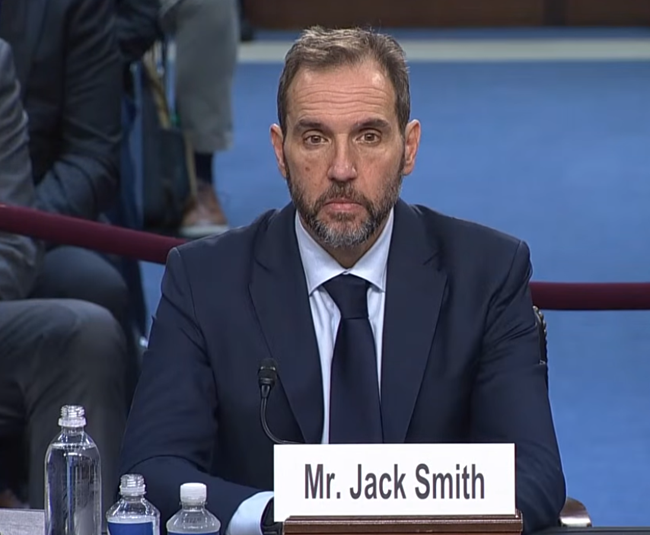
On April 10, 2023, FBI agents working under former special counsel Jack Smith pulled up the phone records of Susie Wiles, Donald Trump's 2024 presidential campaign manager, and began cataloging every number she'd dialed. Twenty-one defense attorneys affiliated with Trump. At least five journalists. Political advisors. The First Lady's contacts. All of it logged, timestamped, and filed under a codename straight out of a spy novel: Plasmic Echo.
They weren't listening to the calls. They didn't need to.
Newly declassified FBI records released by the White House Government Transparency Task Force reveal the scope of Smith's surveillance dragnet against the woman who is now White House Chief of Staff. The documents, first reported by the Daily Signal's Fred Lucas, show that Smith's team obtained a pen register and trap-and-trace device on Wiles' phone — a tool that captures metadata: who called whom, when, and for how long — active from at least February through May 2023. One logged call between Wiles and a Trump-associated attorney lasted 41 seconds. They tracked that, too.
A March 24, 2023 FBI memo contains three full pages of Wiles' phone contacts, categorized as "contacts of interest on the date of her FBI interview" — which took place April 7, 2023. The journalists whose numbers appeared in the dragnet worked at CNN, the Washington Post, Politico, Just the News, 60 Minutes, the Associated Press, Bloomberg, CBS, CNBC, Fox News, the Los Angeles Times, NBC, NPR, the Wall Street Journal, Reuters, New York Magazine, the Washington Times, the Federalist, and the Mark Levin Show.
The operation didn't stop at phone records. On February 3, 2023, the FBI sent preservation requests to Google, Microsoft, MSN, and Yahoo — locking down Wiles' email metadata before she even knew she was a target. A Trump administration official reviewing the documents said, "These are First Amendment activities, reporting, social media, donating, political advice for campaigns, yet Jack Smith's team seemed very interested in them."
The authorization chain makes the scope deliberate, not accidental. Former Deputy Attorney General Lisa Monaco signed off on the investigation as early as March 25, 2022. Former Attorney General Merrick Garland approved it. Former FBI Director Christopher Wray submitted the request. A DOJ memo from the period states that "although members of the 45th Presidential administration are no longer in office, the DOJ Memo states that the scope of this policy should be broadly construed" — meaning anyone in Trump's orbit was fair game, regardless of whether they held a government position.
Former senior FBI agents who reviewed the declassified records described the operation bluntly. "Looks like an intel OP, not a law enforcement probe." One detail stood out to them in particular: the original agent notes from Wiles' interview were supposed to be preserved in an attached 1A file. The agents noted that Smith's team "made the FBI notes disappear."
Another FBI email, dated February 6, 2023, flagged Trump's former National Security Adviser Robert O'Brien. The reason? "It looks like O'Brien is active in endorsing Republican candidates. Can FBI please look at his social media and see if there's anything of relevance we would want to ask him about?" Endorsing candidates. That was the trigger for FBI scrutiny.
An earlier email from June 1, 2022 — before Smith was even appointed — shows an FBI assistant special agent writing: "Even as we continue down the path towards a search warrant, I believe that a reasonable conversation with the former President's attorney...ought not be discounted." The investigation was already moving toward a search warrant on Trump a full four months before the August 2022 Mar-a-Lago raid.
Smith's team also met with former Obama-era CIA Director John Brennan at CIA headquarters in McLean, Virginia in November 2023. The declassified records don't specify what Brennan contributed. They do confirm the meeting happened.
The pen register on Wiles' phone captured her communications with 21 Trump-affiliated attorneys. Attorney-client privilege doesn't technically apply to metadata — the government gets the numbers, the timestamps, the duration, and the frequency without ever hearing a word. But when you're logging which lawyers a campaign chief calls and how often, you don't need the content. The pattern tells the story. Which attorneys are active. Who's coordinating with whom. Where the defense is focusing its energy.
Former FBI officials had a term for this kind of operation: "tickle the wire." You don't tap the line. You map the network.