
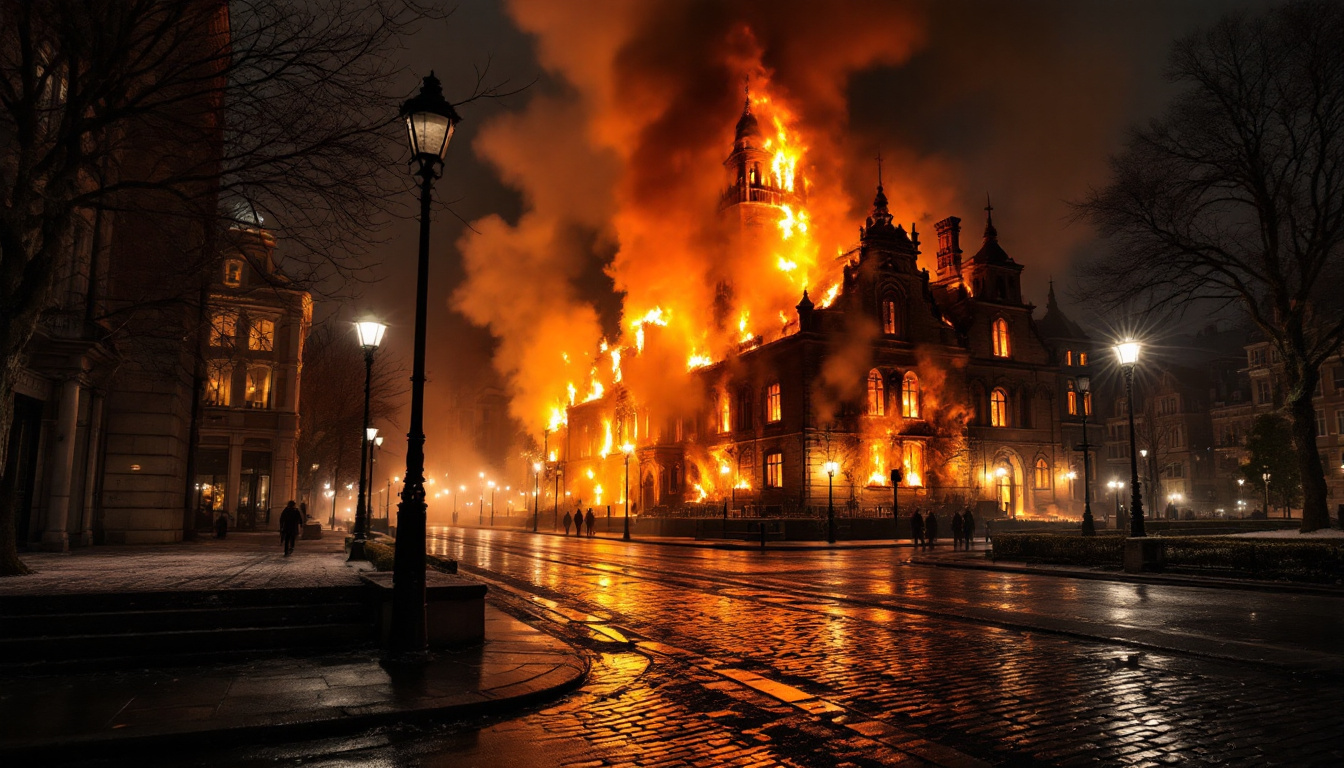
The city hall in Limoges — a building that survived two world wars — burned on Saturday night. Far-left extremists set it on fire while more than half a million people marched across France in what started as a cost-of-living protest and ended as a nationwide riot.
Nearly 900 people were arrested. One hundred and fifty police officers and gendarmes were injured. And that was just day one.
The Spectator's Gavin Mortimer reported Sunday that two separate movements converged on October 17 to create the chaos. A school protest movement that had been building for weeks merged with a revived Yellow Vest march over cost-of-living. The French called it "Jeune/Jaune" — Young/Yellow. The combination put more than 500,000 people into the streets. What happened next had nothing to do with school funding or grocery prices.
Lamia El Aaraje, the Deputy Mayor of Paris, described "a level of violence that I believe we had never seen before." Entire streets in the capital were, in the words of Socialist Mayor of Paris Emmanuel Gregoire, "devastated." Cars ignited. Newspaper kiosks burned. Restaurants set alight. Supermarkets looted clean. Sports stores stripped. Fashion boutiques ransacked. A conservative television station in Paris was besieged.
And Paris wasn't even the worst of it. City halls in Lille and Marseille were badly damaged. The tourist office in Lyon was razed. In Agen, rioters ransacked Marine Le Pen's National Rally branch office. Police fought running battles with mobs in Nice, Toulouse, Rennes, and Bordeaux. In Brest, journalists were targeted.
Prime Minister Sébastien Lecornu issued a statement Saturday evening identifying the source. "Far-left groups have organized acts of violence in several towns and cities across France," Lecornu said. "Criminals have joined in to loot and destroy." He added that France "can be proud of their police officers and gendarmes" — the ones absorbing the 150 injuries.
Le Pen was more specific about the blame. "Legitimate social demands have once again been held hostage by the far left and the speeches of Jean-Luc Mélenchon's MPs, who seek to plunge the country into chaos," she said.
Mélenchon is the leader of La France Insoumise, the hard-left party that has spent years encouraging exactly the kind of revolutionary energy that torched Limoges on Saturday. Back in 2018, during the original Yellow Vest protests, Mélenchon stood at a rally and declared: "I'm not afraid, and I'm not ashamed to say it: what you see here is the New France."
He got his New France. It loots supermarkets and burns down 19th-century buildings.
The Spectator's reporting noted a detail the French government would prefer to blur: the violence came from two distinct groups operating simultaneously. The far-left extremists organizing the destruction were, as Mortimer described, "usually white." The criminals joining in to loot were largely of immigrant background. Young people wearing keffiyehs waved Palestinian flags through the wreckage. The original Yellow Vest movement — middle-aged provincial workers angry about fuel taxes and stagnant wages — was nowhere near the front lines.
The people with legitimate grievances showed up to march. The people with ideological ones showed up to burn.
American Vice President J.D. Vance posted what most of the continent already knows but won't say out loud. "Western liberals imported the third world into France and other countries in the name of diversity and compassion," Vance wrote. No diplomatic hedging. No "complex situation with many contributing factors." Just the sentence.
France has a presidential election coming in April. The country Mélenchon promised — the one where revolutionary politics and mass immigration produce a vibrant new society — is currently boarding up what's left of its shop windows. The legitimate protesters wanted lower prices and better schools. They got water cannons, tear gas, and their movement hijacked by radicals who see a burning city hall as progress.
The original Yellow Vest movement in 2018 rattled the French establishment because ordinary citizens were angry and organized. Eight years later, the sequel isn't ordinary citizens. It's ideologues and opportunists using someone else's grievance as cover.
Nine hundred arrests. A hundred and fifty injured officers. Historic buildings in flames from Limoges to Lyon. And a presidential election six months away.
Mélenchon called it the New France. He wasn't wrong.