
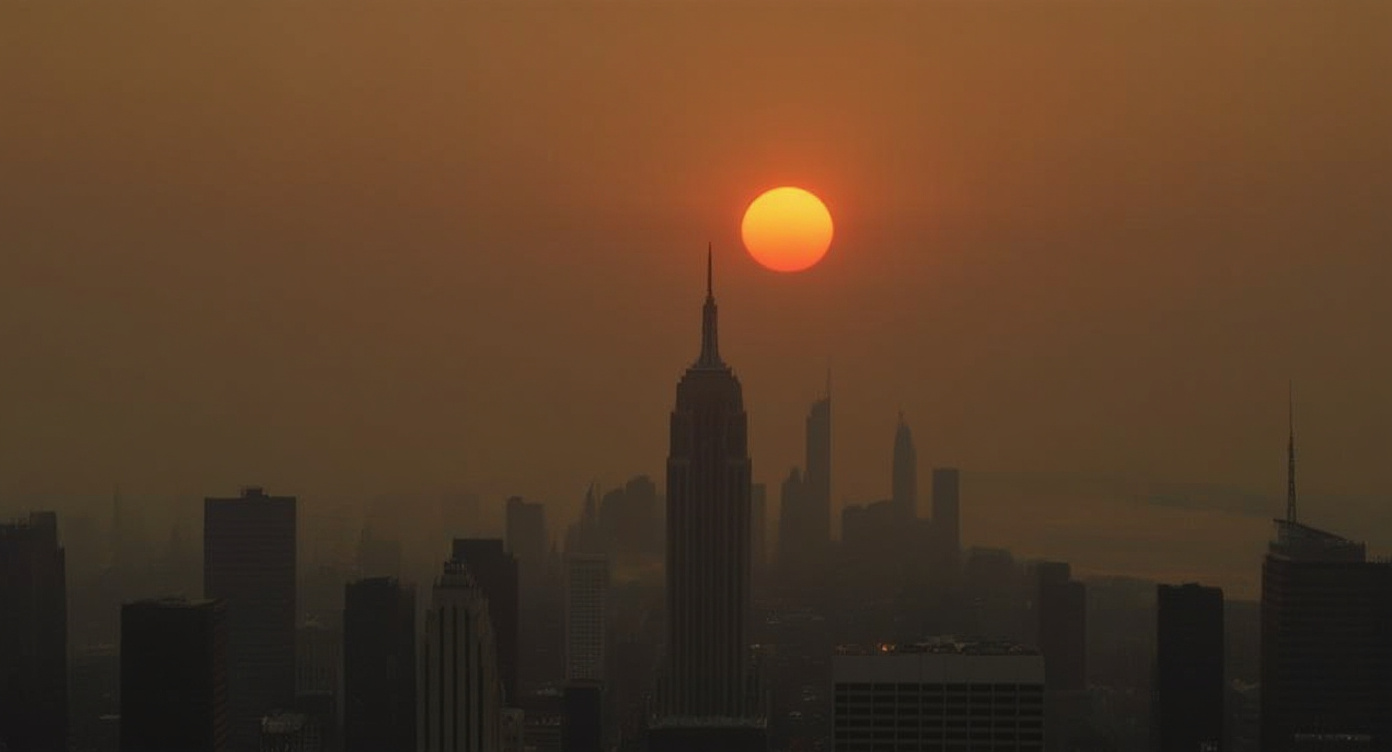
More than 120 million Americans woke up Friday breathing air that scientists compare to smoking half a pack of cigarettes a day. The sky over Washington, D.C. registered an Air Quality Index of 248 — among the three worst in the world, trailing only Chicago and Detroit. Air quality alerts stretched from Boston to Minneapolis, through Pennsylvania, Virginia, Vermont, New Hampshire, and Maine. Emergency rooms are reporting doubled caseloads of respiratory patients.
The source of all of it: Canada. Again.
More than 800 wildfires are burning across Canada right now — the vast majority not contained, burning out of control. Eighteen states and the District of Columbia are under air quality alerts. "Very unhealthy" and "hazardous" designations stretch from northeast Minnesota to southeast Virginia. One hundred and twenty million Americans — not a region, not a city, a third of the country — are breathing the results of Canada's forest mismanagement.
This is year three.
"This is the third consecutive year we have had to write to Canadian officials about a crisis that Canada has the tools to prevent and has chosen not to," wrote Reps. Jack Bergman, John Moolenaar, Lisa McClain, and John James — all Michigan Republicans — in a letter to Canadian Prime Minister Mark Carney this week. "We are done accepting apologies in place of action."
President Trump heard them.
"We are holding Canada responsible for the fact that they are not properly maintaining their Forests, and Brush therein," Trump posted on Truth Social Friday. "The United States is being unnecessarily invaded by filthy, polluted, and unhealthy air, the quality of which is dangerous, and totally unacceptable!" He announced he would call Prime Minister Carney to demand answers, and made clear the financial consequence for continued inaction: "Canada has refused to engage in basic Forest Management and Debris Removal, knowing that such refusal will lead to exactly this result. This is Willful Negligence, and becoming a yearly occurrence, costing the United States Billions of Dollars, which cost of this pollution must of necessity be added to the TARIFFS Canada is currently paying."
Not a warning. A policy.
The health stakes justify the language. Wildfire smoke carries PM2.5 — microscopic particles that bypass the body's natural filtration and travel directly into the lungs and bloodstream. Exposure at current levels is equivalent, by scientific measure, to smoking half a pack of cigarettes every day. Emergency room visits for asthma and COPD can double during events like this. Children, the elderly, and anyone with existing heart or lung disease face the highest risk. Pennsylvania issued a Code Purple air quality alert Friday. Washington went Code Red. This isn't an inconvenience. It's a public health emergency being imported across a border.
EPA Administrator Lee Zeldin confirmed the severity Friday, saying the "impacts of the Canadian wildfires are causing great concern and harm across the United States" and that the EPA would "strongly encourage them to do everything in their power to extinguish these fires as fast as possible."
Congress isn't waiting for Canada to feel encouraged. Rep. John James (R-Mich.) was direct on X: "Thank you, President Trump! Michigan is not Canada's ashtray." James and Sen. Bernie Moreno (R-Ohio) are pushing legislation establishing a 25% tariff on Canadian imports tied to the wildfire damage, with revenue directed toward a victim compensation fund for affected Americans and cleanup costs. Moreno went further, announcing separate legislation to sanction Canada and the specific Canadian government officials responsible for the forestry decisions that produced this outcome three years running.
The argument for tariffs is straightforward. Canada has the land, the equipment, the resources, and the foreknowledge to manage its forests in ways that reduce catastrophic fire risk. It has chosen not to. The cost of that choice — in emergency room visits, in lost outdoor workdays, in health impacts that compound over years — is being borne entirely by American citizens who had no vote in Canadian forest policy. If Canada won't internalize the cost of its negligence through better management, the United States can internalize it through trade.
"The cost is incalculable," Trump said. For 120 million Americans breathing air that ranks among the worst on earth on a July Friday, that's not hyperbole.
It's a number Canada should start calculating.