
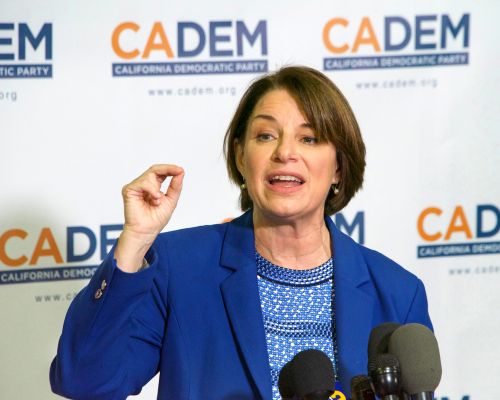
Amy Klobuchar has represented Minnesota in the United States Senate since 2007. That's nineteen years of constituent service, committee hearings, and taxpayer-funded travel — during which federal prosecutors allege that fraud in Minnesota government programs ballooned to a cost of over $9 billion.
On Tuesday night, she won the Democratic-Farmer-Labor Party primary for governor. Her pitch? She's going to clean it all up.
The former 2020 presidential candidate cruised past a field of long-shot challengers in the primary, positioning herself for the November 2026 general election to replace outgoing Governor Tim Walz. Walz, you may recall, dropped out of his re-election bid amid mounting criticism that his administration fumbled the fraud prevention efforts that let billions in taxpayer money walk out the door.
So naturally, the Democratic solution is to hand the keys to someone who's been in elected office in the same state the entire time the fraud was metastasizing. Klobuchar — born in Plymouth, Minnesota, former Hennepin County attorney — isn't exactly a fresh face parachuting in from the outside. She's been right there. For two decades.
Her campaign even features a policy plank titled "Make Government Accountable and Root out Fraud." She promised voters a "top-to-bottom audit" of state government starting "day one." Which raises a reasonable question: what was she doing on days one through six thousand, nine hundred and thirty-five?
"You are right to be angry about the fraud," Klobuchar told supporters. "It is unacceptable and it must end."
Correct on all counts. But there's something about a sitting U.S. Senator — whose current term doesn't even expire until January 2031 — telling voters she needs a different government job to address a crisis that happened under her party's watch, in her state, while she held one of its two most powerful federal offices. The fraud didn't happen in a vacuum. It happened in a state where Democrats controlled the governor's mansion and held both Senate seats.
Republicans have hammered the $9 billion taxpayer price tag for months, and for good reason. That's not a rounding error. That's a scandal large enough that in most states it would disqualify the ruling party from dogcatcher, let alone the governor's mansion. In Minnesota, it apparently qualifies you for a promotion.
The playbook writes itself. Walz presided over the mess. Klobuchar supervised nothing from Washington while it grew. Walz exits. Klobuchar slides in promising accountability — the same accountability that was apparently unavailable during the previous two decades of her career in Minnesota politics.
The last time Minnesota had a governor from outside the current political machine was Tim Pawlenty, who left office in January 2011. That was fifteen years ago. Since then, the Democratic-Farmer-Labor Party has held the mansion continuously, and the $9 billion fraud tab landed squarely on their watch.
Klobuchar's 2020 presidential campaign ended before Super Tuesday. Now she's back, running for a smaller office with a bigger mess — and asking voters to believe the person who watched it happen is the best person to fix it.
That's not a campaign platform. That's a job application where the reference is the crime scene.